The Rise of Answer Agent Optimization
From "Find Me" to "Choose Me" — why the next era of digital discovery is about AI agents that act, not search engines that rank.
The Rise of Answer Agent Optimization
From "Find Me" to "Choose Me" — Why the next era of digital discovery isn't about search, and it isn't about answers. It's about delegation.
The Scenario That Changes Everything
Imagine this. It's 2027. A marketing director needs project management software for her 50-person team.
She doesn't open Google. She doesn't even ask ChatGPT to "list the best project management tools."
She says: "Find the best project management tool for my team. We need Jira integration, under $15/user/month, SOC 2 compliant. Set up a trial, schedule a demo with their sales team, and give me a comparison report by Friday."
Her AI agent goes to work. It evaluates dozens of tools — reads documentation, checks API compatibility, verifies compliance certifications, compares pricing structures, cross-references user reviews with industry benchmarks. It sets up two trial accounts, configures them with sample data, schedules demos, and delivers a comprehensive report. All without the marketing director visiting a single website.
Here's the question that should keep you up at night: When that agent evaluated your product, did it even know you existed? And if it did, could it actually take action on your behalf?
This scenario isn't science fiction. Visa and Mastercard are already building payment infrastructure for AI agents. McKinsey projects the agentic commerce market will reach $3-5 trillion by 2030. Multi-agent system inquiries surged 1,445% from Q1 2024 to Q2 2025.
The question isn't whether this future is coming. It's whether your business will be visible when it arrives.
Three Eras of Digital Discovery
To understand where we're going, we need to understand where we've been.
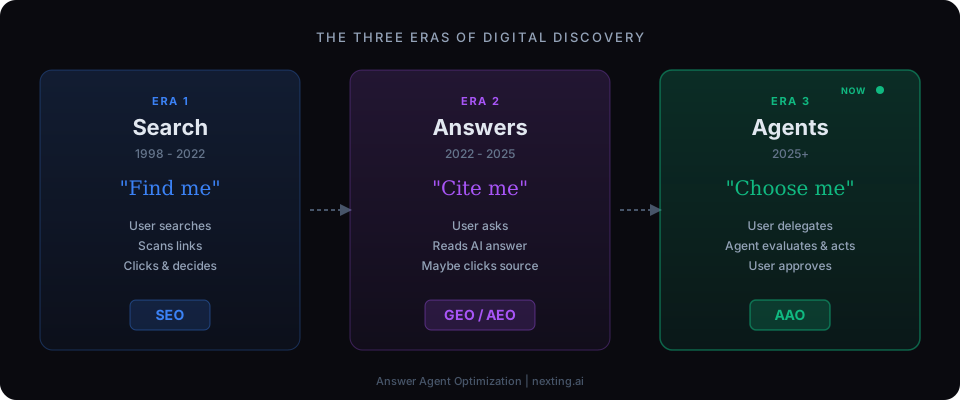
Era 1: Search (1998-2022) — "Find Me"
The search era was built on a simple contract: you create content, search engines index it, users find it through queries.
The optimization discipline that emerged — SEO — was fundamentally about making your content findable. Keywords, backlinks, page speed, meta tags. The goal was straightforward: rank higher so users can find you.
The user's job: Type a query, scan results, click links, evaluate options, make a decision.
What businesses optimized for: Rankings, click-through rates, organic traffic.
Era 2: Answers (2022-2025) — "Cite Me"
When ChatGPT launched in November 2022, it shifted the paradigm. Users stopped scanning ten blue links. They started asking questions and expecting direct answers.
This spawned a flood of new terminology — GEO (Generative Engine Optimization), AEO (Answer Engine Optimization), LLMO (Large Language Model Optimization). At least seven competing acronyms emerged, all describing roughly the same thing: optimizing your content so AI systems cite you in their responses.
The user's job: Ask a question, read the AI-generated answer, maybe click a source link.
What businesses optimized for: Being cited, being mentioned, appearing in AI-generated responses.
This was progress. But it was also incremental thinking — retrofitting the search paradigm onto AI. The fundamental assumption remained the same: a human asks, a system responds, the human decides.
That assumption is about to break.
Era 3: Agents (2025+) — "Choose Me"
We are entering the Agent Era. The shift isn't from "search" to "answers." It's from humans making decisions to AI agents making decisions on behalf of humans.
This is a fundamentally different problem.
When a user asks ChatGPT "what's the best CRM?", ChatGPT is acting as an answer engine. It synthesizes information and presents options. The user still decides.
When a user tells an AI agent "evaluate CRM options for my company, set up trials for the top three, and recommend one" — that agent isn't answering a question. It's acting. It's evaluating, comparing, selecting, and transacting. It has agency.
The user's job: Delegate the task, review the agent's work, approve.
What businesses need to optimize for: Being understood, trusted, selected, and integrated into agent workflows.
This is Answer Agent Optimization (AAO).
Why This Distinction Matters
You might think: "Isn't this just semantics? If I optimize for AI answers, won't the agents find me too?"
No. Here's why.
Agents Don't Just Read — They Act
Answer engines consume your content and summarize it. Answer agents consume your content and make decisions based on it. The optimization requirements are fundamentally different.
An answer engine needs to cite you accurately. An answer agent needs to:
- Verify your claims against other sources
- Evaluate your offering against alternatives
- Access your APIs to check pricing, availability, and compatibility
- Initiate transactions, trials, or integrations
- Report outcomes back to the user
Content optimization alone is insufficient. You need to optimize your entire digital surface area — APIs, structured data, product feeds, documentation, machine-readable formats — for agent consumption.
Agents Have Memory and Context
A search engine treats every query independently. An answer agent builds context over time. It knows the user's preferences, past decisions, budget constraints, and strategic priorities.
This means agent preference isn't just about your content quality today. It's about your relationship with the agent ecosystem over time. Agents that have successfully recommended your product before will be more likely to recommend it again — if the outcomes were positive.
Agents Are Intermediaries with Judgment
When Google ranks you #1, it's an algorithm matching signals. When an AI agent recommends you, it's making a judgment call. It's putting its credibility with the user on the line.
This changes the trust equation entirely. Agents need stronger signals of trustworthiness, reliability, and quality than search engines ever did. They need to be confident in their recommendation because the user has delegated authority to them.
Agents Use Tools, Not Just Web Pages
This might be the most important technical difference. Agents don't just browse websites. They:
- Call APIs to check real-time pricing and availability
- Access structured data feeds for product comparisons
- Use MCP (Model Context Protocol) servers for tool integration
- Process machine-readable specifications and documentation
- Interact with trial and demo environments programmatically
If your digital presence is optimized only for human visitors — beautiful websites, marketing copy, hero images — agents can't effectively evaluate you. You need a machine-readable layer that agents can consume and act upon.
The AAO Framework: Five Dimensions
Through building AI visibility infrastructure and analyzing how AI agents evaluate and select products, we've identified five critical dimensions that determine whether an agent will discover, understand, trust, act on, and ultimately choose your offering.
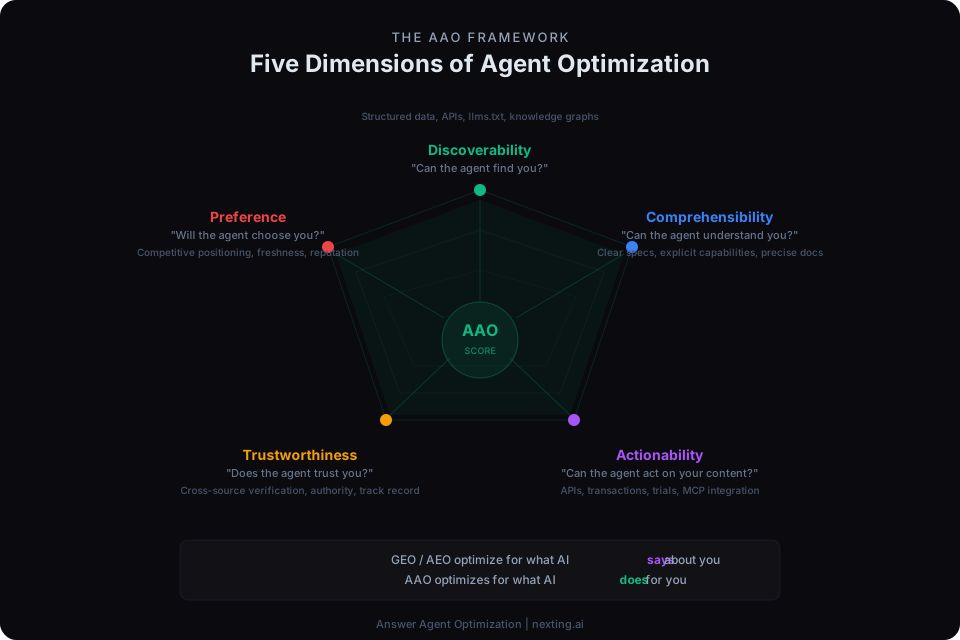
1. Agent Discoverability
Can the agent find you?
Before an agent can recommend you, it needs to know you exist. In the Search Era, this meant appearing in Google's index. In the Agent Era, it means being accessible across a fragmented ecosystem of AI platforms, tools, and protocols.
What matters:
- Presence in AI training data and knowledge bases
- Structured data (Schema.org, JSON-LD) that agents can parse
- LLM-friendly files (llms.txt, comprehensive sitemaps)
- API endpoints that agents can query programmatically
- MCP server integration for tool-use scenarios
- Presence in AI directories and knowledge graphs
The shift: SEO made you findable in one search engine. AAO makes you findable across an ecosystem of agents, each with different architectures, training data, and tool-use capabilities.
2. Agent Comprehensibility
Can the agent understand you?
Being found is meaningless if the agent can't accurately understand what you offer. AI agents need to construct a precise model of your product, service, or content — not from a marketing perspective, but from a functional one.
What matters:
- Clear, unambiguous value propositions (not marketing fluff)
- Structured product and service specifications
- Explicit capability descriptions (what you do and don't do)
- Relationship mapping (how you compare to alternatives)
- Context-rich documentation with use cases and constraints
The shift: SEO keywords told search engines what category you're in. AAO comprehensibility tells agents exactly what you can do, for whom, under what conditions, and with what limitations. Agents need precision, not persuasion.
3. Agent Trustworthiness
Does the agent trust you?
AI agents are risk-averse by design. They make recommendations on behalf of users who've delegated authority. A bad recommendation erodes the agent's credibility. So agents seek strong trust signals before recommending.
What matters:
- Consistency of information across independent sources
- Authority signals (domain expertise, industry recognition, certifications)
- Track record evidence (reviews, case studies, measurable outcomes)
- Freshness (regularly updated content reflecting current reality)
- Transparency (clear pricing, terms, and limitations — not hidden behind "contact us")
The shift: SEO authority was about backlinks. AAO trustworthiness is about verifiable claims corroborated across multiple independent sources. Agents cross-reference. They're harder to fool than algorithms.
4. Agent Actionability
Can the agent act on your content?
This is the dimension that separates AAO from everything that came before. GEO and AEO care about content. AAO cares about what an agent can do with that content.
What matters:
- API access for programmatic evaluation (pricing, availability, features)
- Trial or demo environments that agents can set up autonomously
- Machine-readable product catalogs and comparison data
- Clear transaction pathways (can an agent initiate a purchase or signup?)
- Integration documentation for agent workflows and tool-use protocols
The shift: SEO and GEO optimize content for reading. AAO optimizes your entire digital surface for agent interaction. If an agent can't check your pricing, try your product, or initiate a transaction programmatically, you're invisible in the agent economy.
5. Agent Preference
Will the agent choose you?
All else being equal, which offering will the agent recommend? Agent preference is the compound result of the previous four dimensions, layered with competitive dynamics and historical outcomes.
What matters:
- Competitive positioning in agent responses (how you're described relative to alternatives)
- User satisfaction signals from previous agent-mediated interactions
- Freshness advantage (the most current information wins in tie-breakers)
- Completeness of information (agents prefer confident recommendations with full data)
- Agent-to-agent reputation (as multi-agent systems emerge, reputation propagates across agents)
The shift: SEO ranking was a position on a list. AAO preference is a judgment by an intelligent system weighing dozens of signals. You can't game it with link schemes. You earn it with genuine quality, transparency, and agent-readiness.
The Evidence: Why Now
This isn't theoretical. The shift is measurable.
AI usage is exploding
| Metric | Data |
|---|---|
| ChatGPT weekly active users | 800 million (March 2025) |
| Perplexity daily queries | 30 million (up from 3,000 in 2022) |
| AI-driven traffic growth | 1,200% (July 2024 to February 2025) |
| AI-sourced website traffic increase | 527% (January to May 2025) |
Traditional search is declining
| Metric | Data |
|---|---|
| Gartner's prediction for search volume | 25% drop by 2026 |
| Google queries ending without a click | ~60% |
| Zero-click news searches after AI Overviews | Grew from 56% to 69% |
The agentic economy is forming
| Metric | Data |
|---|---|
| McKinsey: Agentic commerce market by 2030 | $3-5 trillion |
| Enterprise apps embedding AI agents by 2026 | 40% (Gartner) |
| Consumers using AI in purchasing journey | 73% |
| Multi-agent system inquiry growth (Q1 2024 to Q2 2025) | +1,445% |
The infrastructure is being built. Visa and Mastercard are creating payment rails for AI agents. Microsoft declares "marketing has entered the agentic era." The agentic commerce wave isn't a prediction — it's a deployment.
The terminology is still open
At least seven competing terms describe the space: GEO, AEO, LLMO, AISO, AIO, AIAO, and AI SEO. Only 3% of SEO thought leaders reference any new term in their professional profiles. Google dismisses all the new acronyms, saying "good SEO is good GEO."
The industry hasn't settled on a framework because none of the existing terms capture the full picture. They all describe content optimization for AI answers. None describe the deeper challenge of optimizing for AI agents that act.
That's the gap AAO fills.
What AAO Means for Your Business
B2B SaaS
Your buyers are already using AI agents for vendor research. Soon, agents will shortlist vendors, set up trials, and deliver recommendations — all before a human reviews. If your product isn't agent-discoverable, agent-comprehensible, and agent-actionable, you won't make the shortlist.
Start here: Structured API documentation, machine-readable feature comparisons, transparent pricing, automated trial setup.
E-Commerce
AI shopping agents are the next frontier. When agents start purchasing on behalf of consumers, the winners will be products with structured data feeds, real-time inventory APIs, clear specifications, and strong review signals.
Start here: Product feed optimization, API access for agent queries, structured reviews and ratings, transparent shipping and returns data.
Professional Services
When a CEO tells their AI agent "find me a consulting firm that specializes in supply chain optimization in Southeast Asia," the agent won't browse your website. It'll programmatically verify credentials, cross-reference case studies, and evaluate expertise against competitors.
Start here: Structured credentials, verifiable case studies, machine-readable expertise profiles, transparent methodology documentation.
Content and Media
AI agents curate content recommendations, assemble research briefings, and suggest experts for podcasts and panels. Your content needs to be parseable, quotable, and attributable by agents — not just readable by humans.
Start here: Structured authorship data, clear expertise signals, well-organized content taxonomies, persistent identifiers.
The AAO Audit: Five Questions
Before optimizing, understand your current agent readiness. Ask these five questions:
1. Discoverability: If I ask ChatGPT, Claude, and Perplexity about my product or category, do I appear? In what context?
2. Comprehensibility: When AI mentions me, does it accurately describe what I do? Or is the description vague, outdated, or wrong?
3. Trustworthiness: Do multiple independent sources corroborate my claims? Can an agent verify my authority?
4. Actionability: Can an AI agent programmatically check my pricing, evaluate my features, or initiate a transaction? Or is everything locked behind human-facing interfaces?
5. Preference: When an agent compares me to alternatives, do I come out favorably? What signals am I missing?
These five questions reveal your AAO gaps faster than any audit tool.
The Road Ahead
We're at the beginning of the Agent Era. The terminology hasn't solidified. The best practices haven't been codified. The winners haven't been decided.
This is exactly the right time to build.
At Nexting, we've been building infrastructure for AI visibility since before most of these acronyms existed. Our work tracking brand visibility across ChatGPT, Perplexity, Claude, and other AI platforms has given us a front-row seat to the transition from answer engines to answer agents.
What we've observed is unambiguous: the companies that prepare for agents now — by making their digital presence discoverable, comprehensible, trustworthy, actionable, and preferable to AI — will hold an insurmountable advantage over those who wait.
SEO rewarded those who understood search engines early. GEO is rewarding those who understand AI answers. AAO will reward those who understand AI agents.
The Agent Era rewards the prepared.
This essay introduces Answer Agent Optimization as a framework for understanding the next evolution of digital discovery. We'll continue exploring each of the five dimensions in depth in future articles.
If you're building for the Agent Era, we'd like to hear from you. Reach out at nexting.ai.