Bring Your Own Agent: Use the Agents You Already Run
Nexting connects the agents you already run — Claude Code, OpenClaw, and Codex — instead of replacing them with a proprietary assistant. What BYOA means, how remote control works, and what the optional Plus tier adds.
Eric Shang
Founder, Nexting Inc.
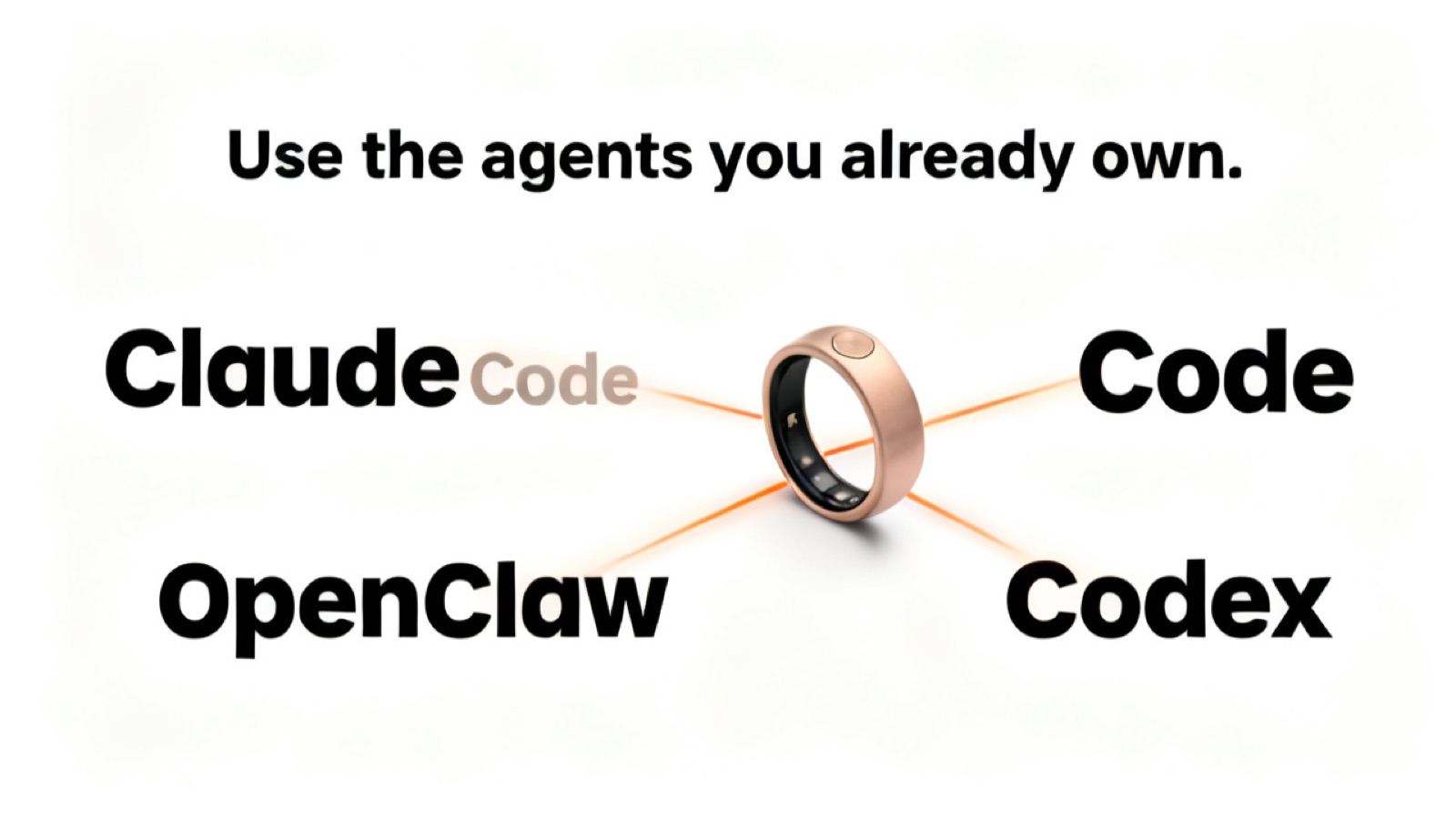
Bring Your Own Agent (BYOA) is the idea that the AI on your device should be the AI you already own and run — not a proprietary assistant the hardware vendor rents back to you. With Nexting, BYOA is free: connect the agents you already use, like Claude Code, OpenClaw, and Codex, and dispatch them from a wearable with no monthly fee. It matters because ownership, not rental, is what determines your capability ceiling, your cost, your privacy, and whether the thing still works in three years.
The default AI gadget is a rental you cannot inspect
Walk through the first generation of dedicated AI hardware and a pattern repeats with almost comic regularity. You buy the device once, then you keep paying. The intelligence inside it is not yours; it is leased to you on the vendor's terms, served from the vendor's cloud, powered by the vendor's choice of model. You do not get to swap that model when a better one ships. You do not get to point the device at the coding agent already running on your laptop. You do not get to read the code that decides what happens to your voice. You get a glossy object and a recurring charge, and you get to hope the company behind it stays solvent.
That hope is not idle. The most expensive lesson of the category so far is that the rental can be switched off entirely. When a device's brain lives on someone else's servers, the brain can be evicted — and your hardware becomes a paperweight the moment the business model fails.
BYOA is the structural answer to that failure mode. Instead of treating the agent as something the device ships with and meters, it treats the agent as something you bring. The hardware becomes a dispatcher — a way to talk to AI you already control — rather than a storefront for AI you must keep buying.
The tell, in almost every case, is that you cannot answer a simple question in the affirmative: can I point this device at the AI I already use? For the first wave of gadgets the answer was uniformly no. You could use the assistant they chose, the way they configured it, for as long as they kept the lights on. That is not a product you own; it is a product you are allowed to use, which is a very different thing once you have paid full retail for the object sitting on your body.
What “bring your own agent” actually means
The phrase borrows from a lineage software teams already know. “Bring your own device” let employees use their own laptops at work. “Bring your own key” (BYOK) let companies supply their own provider API key or their own encryption key instead of paying an app for bundled model usage. As one BYOK explainer puts it, bringing your own key means you can change tools without changing your AI account — you keep your usage history, your billing controls, and the ability to switch front-ends when a better workflow appears.
Bring Your Own Agent takes that one rung higher. A key is access to a model. An agent is a whole working entity: a model plus its tools, its memory, its permissions, its file access, its workflows, and the harness that lets it actually do things rather than just talk. When you bring your own agent, you are not just supplying a credential — you are supplying a capability you have already configured and trust.
Concretely, with Nexting
BYOA on a Nexting wearable means you connect the agents you already run and dispatch them by voice, hands-free, with no app and no monthly fee for the connection itself:
- Claude Code — the coding agent running on your own Mac. Dispatch a task from your collar, then watch the running session live from your pocket and answer its prompts while you walk away.
- OpenClaw— the open plugin standard, running on your own device, wired into whatever tools and integrations you have already set up.
- Codex— your own coding agent session, dispatched and steered from your body instead of your keyboard.
The deep integrations are specific and named — this is not a vague promise to support “any backend.” Nexting connects to the agents it has actually built support for. But the ones it connects to, you own. The keys stay with you. The agent stays on your hardware. The wearable is the microphone and the messenger, not the brain.
“The device should be a dispatcher for the AI you already trust — not a turnstile in front of an AI you have to keep paying to walk through.”
An agent is not an assistant — and the difference is the whole argument
It is tempting to treat “assistant” and “agent” as marketing synonyms, but the gap between them is exactly what makes BYOA matter. An assistant answers. An agent acts. An assistant is a conversation partner that produces text when you prompt it; an agent is a worker that takes a goal, makes a plan, uses tools, touches files, runs commands, checks its own results, and comes back with the thing done rather than described.
The first generation of AI wearables shipped assistants. You asked, it talked back, and the loop closed when the talking stopped. That is genuinely useful for quick facts and quick notes, but it is a thin slice of what AI can now do. The frontier of value has moved to agents that finish real work — refactor a module, triage an inbox, run a multi-step research task, drive a build — and that kind of capability is not something a vendor can meaningfully pre-bake into a sealed pendant. It lives in the harness you have set up: the tools you connected, the repositories the agent can see, the permissions you granted, the memory it has built up about how you work.
That is the deep reason BYOA is not a pricing gimmick. The most capable agent you have access to is almost certainly the one you have already configured on your own machine, not the one a hardware company could license and freeze into firmware. Bringing your own agent is the only way to put that full capability on your body. A sealed assistant, by construction, can never be more than what the vendor shipped on launch day.
“You cannot ship someone else's best agent in a sealed box. The most capable AI you can put on your body is the one you already built.”
Why ownership beats rental, on four axes
“Own your AI” sounds like a slogan until you break it into the dimensions that actually change your day. There are four that matter: capability, cost, privacy, and longevity. On each one, the owned agent and the rented assistant diverge — and the gap widens over time.
1. Capability: your ceiling is your agent, not the vendor's SKU
A rented assistant gives you exactly the capabilities the vendor decided to ship, frozen at the vendor's release cadence. If they wired in one model, that is your model. If a stronger one launches next month, you wait until the vendor decides to integrate it — if they ever do.
An owned agent inherits everything you have already built into it. The tools you have connected, the files it can read, the workflows you have taught it, the memory it has accumulated — all of it comes along when you dispatch from a wearable. Your capability ceiling is whatever you have made your agent capable of, and it rises every time you improve your own setup, not every time a hardware company ships a firmware update.
The compounding here runs in your favor. Every new tool you wire into your agent, every model upgrade you adopt, every workflow you refine instantly becomes available on your body, because the wearable is just a doorway to the same agent. A rented assistant compounds in the vendor's favor instead: improvements arrive on their schedule, scoped to what their business case justifies, and the device you bought is frozen at whatever capability shipped the day it left the factory.
2. Cost: the recurring charge is the product
For rented AI hardware, the subscription is not a tax on the product; it is the product's actual business model, and the device is the customer-acquisition cost. That is why the monthly fee tends to be mandatory rather than optional, and why it persists for the life of the device. We will put real numbers on this below, but the structural point is simple: when you bring your own agent, you are already paying your own provider whatever you choose to pay them, and the wearable adds nothing on top of that for the connection.
3. Privacy: where the keys and the content live
An always-on wearable hears your life, so the privacy question is not rhetorical. In a rented model, your audio and text flow to the vendor's cloud, processed under the vendor's policy, retained for the vendor's purposes. In BYOA, the agent runs on your own device and your keys stay with you.
Nexting's BYOA modes offer optional end-to-end encryption, currently off by default: when enabled, the cloud relays ciphertext, not readable content. The relay moves bytes between your wearable and your agent without being able to read them. That is a meaningfully different posture from “trust us with the plaintext.” Nexting does not train on, sell, or share your data, and you can delete it at any time.
The distinction between a policy and an architecture is the whole point. “We promise not to look” is a policy — it depends on the vendor's good behavior, their security, and their continued existence. “We cannot read it because it is encrypted end-to-end and the keys are on your device” is an architecture, and architectures survive bad days that policies do not. For an always-on device that may be in the room for your most sensitive conversations, the difference between “we choose not to” and “we are not able to” is the difference worth paying attention to.
4. Longevity: an owned agent cannot be remotely bricked
This is the axis the first generation taught everyone the hard way. If the intelligence lives on the vendor's servers, the vendor can turn it off — through bankruptcy, acquisition, or a strategy pivot. If the intelligence is your own agent on your own hardware, there is no kill switch in someone else's data center. The dispatcher is a relatively simple piece of hardware; the brain is yours, and it keeps working as long as you keep running it.
The cautionary tale: a $700 pin with a $24 lease
The clearest illustration of the rental trap is the device that defined and then deflated the category. The Humane AI Pin launched at $699 and required a $24-per-month subscription on top — the subscription was not optional, because the device's intelligence was served entirely from Humane's cloud through a single provider relationship. Sluggish sales forced a price cut from $699 to $499, but the recurring fee stayed.
Then the part that should make every buyer of rented AI hardware pause: in February 2025, HP acquired Humane's assets for $116 million, and the Ai Pin business was shuttered. Existing devices stopped connecting to Humane's servers on February 28, 2025. The hardware you paid up to $699 for — plus every monthly payment — lost its brain on a date the company chose, not you. According to the reporting, Humane had burned through roughly $230 million in investor cash before the sale.
“When the brain is in someone else's cloud, the off switch is in someone else's hands. BYOA puts both back in yours.”
The lesson is not that wearable AI failed. It is that renting your intelligence from a single vendor is a fragile arrangement, no matter how polished the object. The Pin was beautiful and doomed by the same fact: you never owned the part that mattered.
The lock-in pattern across the category
Humane was not an outlier. Single-provider lock-in is the norm across the first wave of consumer AI hardware. The shape recurs: one device, one assistant, no way to bring your own.
- Humane AI Pin — $499 (cut from $699) plus a required $24/mo, single provider, closed, now discontinued.
- Rabbit R1— $199, runs Rabbit OS only. It has iterated impressively since its rocky 2024 launch, but the device is the front-end to Rabbit's own stack, not yours.
- Meta Ray-Ban — $299 and up, wired to Meta AI only. Excellent glasses; one assistant, chosen by Meta.
- Friend— $99, the Friend AI companion only. The product is the personality; you cannot swap it for your own agent.
- Bee— $49.99 plus a subscription, Bee AI only.
- Plaud NotePin — $169, locked to its own service.
Every one of these is a perfectly reasonable product on its own terms. But they share a design assumption that BYOA rejects: that the assistant ships with the hardware and is the hardware's reason to charge you. In each case the answer to “can I use the AI agent I already run?” is no.
The economics: free to own vs. forever to rent
The cleanest way to see why ownership wins is to total the cost over time. The wearable's purchase price is a one-time number; the subscription is a slope. The longer you own the device, the more the slope dominates, and the more a free-to-connect model pulls ahead.
The table below compares the Nexting PIN with BYOA — free to connect your own agent — against representative subscription-bearing wearables. For BYOA, the device is $129 and there is no fee to connect your own Claude Code, OpenClaw, or Codex agent. (You pay your own AI provider whatever you already pay them, exactly as you would with or without a wearable; the wearable adds nothing.) The subscription column is the recurring cost the device itself imposes.
| Device | Up front | Required sub | 1-year total | 2-year total | 3-year total |
|---|---|---|---|---|---|
| Nexting PIN (BYOA) | $129 | $0 | $129 | $129 | $129 |
| Nexting PIN + Plus | $129 | $29/mo | $477 | $825 | $1,173 |
| Humane AI Pin | $499 | $24/mo | $787 | $1,075 | $1,363* |
| Bee | $49.99 | subscription | $50 + sub | $50 + sub | $50 + sub |
| Rabbit R1 | $199 | Rabbit OS only | $199 | $199 | $199 |
*Humane AI Pin three-year total is hypothetical: the device and service were discontinued in February 2025, which is exactly the longevity risk this article is about. Rabbit R1 has no mandatory monthly fee but is locked to Rabbit OS — you cannot bring your own agent at any price.
Read down the BYOA row and the number never moves: $129, year after year. Read down the rented rows and the totals climb past a thousand dollars while you do nothing differently. The Humane line is the starkest — not because the third-year number is the highest, but because that number is fictional. You could not have reached year three. The service was gone.
Subscription fatigue is now the market's default mood
This is not a niche complaint. By 2026, Americans pay for an average of four premium AI subscriptions at roughly $66 a month, and 53% cancel and restart AI tools as needed rather than carry them. The financial burden of stacking individual plans averages over $1,200 a year per power user. Across all subscriptions, 47% of consumers actively canceled at least one service in 2026, up from 31% in 2024, and the top reason — cited by 52% — is simply “too many subscriptions.”
Stack that against the wider picture and the case sharpens. U.S. households now spend roughly $273 a month on subscriptions of all kinds, and 89% of people underestimate that total — the bleed is real and largely invisible. Into that environment, a device that demands its own mandatory monthly fee for AI is asking to be the line item that gets cut first. Worse, the AI industry's subsidized, all-you-can-eat pricing has been ending, which means rented AI costs are more likely to drift up than down. A BYOA device sidesteps both pressures: it adds no new subscription of its own, and your provider relationship is one you chose and can change.
There is a subtler cost to rental, too: the cost of switching. Part of why subscriptions are sticky is that leaving means losing your history, your settings, your accumulated context. When your agent is your own, switching the wearable — or even the model behind your agent — does not cost you any of that, because the agent and its memory never lived in the device to begin with. Ownership is not just cheaper per month; it is cheaper to walk away from, which is the freedom subscriptions are designed to take from you.
The trust signal is even clearer. Consumers no longer accept subscriptions that are hard to understand or hard to leave; 82% are more likely to subscribe when cancellation is easy, and 78% want pause-or-swap options. A wearable that bolts a mandatory monthly fee onto your AI bill is walking directly into that headwind. A wearable that lets you bring the agent you already pay for — and charges nothing extra to connect it — is walking with it.
How BYOA works, at a high level
You do not need to understand the plumbing to benefit from it, but the shape is worth seeing, because it is what makes the privacy and ownership claims real rather than rhetorical.
The three pieces
- Your agent, on your hardware. Claude Code on your Mac, OpenClaw or Codex on your own machine. This is where the intelligence, the keys, and the file access live. None of it moves to Nexting.
- The wearable, on your body. The PIN (or Ring) captures your voice and plays back results. It is a dispatcher and a speaker, not a brain. It holds no model.
- The relay, in the middle. A thin cloud path carries messages between the wearable and your agent. In BYOA modes it carries ciphertext — encrypted end-to-end, so the relay moves your bytes without being able to read them.
The interaction: dispatch, not chat
The point of putting an agent on your body is not to stare at a token stream on a tiny screen. It is to dispatch and walk away. You say one sentence. The wearable hands it to your agent. The agent runs the task in the background — on your machine, with your tools — while you keep moving, while your phone is locked, while you are nowhere near a keyboard. When it has a result or a question, it comes back to you.
For a long-running coding agent, you can go further: dispatch a task to a Claude Code session and then, from your pocket, watch that running session live, answer its prompts, and keep it working while you step away from the desk. The wearable becomes a remote control for an agent that is genuinely yours.
Why this is the right shape for a wearable
Notice what this interaction model does not require. It does not require a screen big enough to read a transcript. It does not require your hands. It does not require you to stay put while the work happens. Those three constraints are exactly the ones that doomed the “phone replacement” framing of the first AI wearables, which tried to cram a visual computing experience onto a chest or a lapel and failed at it. Dispatch sidesteps all of them, because the heavy lifting happens on a real machine and only the start and the finish need your attention.
That is also why BYOA and the dispatch model fit together so naturally. If the wearable held the brain, it would be limited by the wearable's tiny compute and battery. Because the brain is your own agent on your own hardware, the wearable can stay small, light, and long-lived — its only jobs are to listen well, to talk back clearly, and to keep a secure line open to the agent that does the actual thinking.
A day with an owned agent on your collar
The abstraction gets concrete fast once you picture the moments. None of these require you to open an app or look at a screen; all of them dispatch to an agent that is yours.
- On the walk to the train. “Have Claude Code add the retry logic to the upload handler and run the tests.” You keep walking. By the time you sit down, the session has a branch ready and a question waiting, which you answer from your pocket without breaking stride.
- Mid-errand. “Ask my agent to pull the three contracts due this week and summarize what changed.” The agent reads files it already has access to on your machine; the summary comes back when it is done, not while you stand and stare.
- In the moment an idea hits. “Start a Codex session to prototype the import script we talked about.” The work begins on your hardware before you have found a desk.
- Reviewing a long run. A coding task you dispatched an hour ago hits a decision point. The wearable surfaces the prompt; you answer one line; the run continues. You never opened the laptop.
The throughline is that the intelligence in each of these scenes is something you already own and trust. You are not learning a new assistant's quirks or hoping the vendor wired in the tool you need. You are extending the reach of the agent you have already shaped, out from the desk and onto your body.
What is quietly radical about this is how little the wearable has to be. It does not need to be a phone, a camera array, or a tiny projector. It does not need to win a benchmark or run a model locally. It needs to hear you well, talk back clearly, and keep a secure, reliable line to your agent — and then get out of the way. That modesty is a feature, not a compromise. A device with a narrow, honest job can be smaller, cheaper, longer-lived, and less likely to disappoint than one that promised to replace the supercomputer in your pocket and could not.
When renting is the right call: Nexting Plus
Ownership is not free of work. Running your own agent means you have an agent to run — a machine that stays on, a provider account you manage, a setup you maintain. For a lot of people that is exactly the point; they already live in Claude Code or Codex and want to take it with them. For others, the setup is friction they would happily pay to skip.
That is what Nexting Plus is for. Plus is a separate, fully managed mode: hosted models — Claude, GPT-4o, Gemini — with zero setup. You do not stand up an agent, you do not manage keys, you just talk and it works. Plus is optional and priced at $29/month, or $279/year (about $23/month, an 18% saving).
Two honest things about Plus. First, it is a real subscription — it is the rental option, offered openly as a choice rather than forced as the only path. Second, because the models are hosted, managed Plus needs the cloud and cannot offer the same end-to-end posture as BYOA, where the agent and keys never leave your hands. That is the trade you are making: convenience for the local-ownership guarantees. We would rather state it plainly than blur the line.
Which path fits you
| If you… | Pick |
|---|---|
| Already run Claude Code, OpenClaw, or Codex | BYOA (free) |
| Want maximum privacy — keys and agent stay with you | BYOA (free) |
| Want the lowest total cost over years | BYOA (free) |
| Want zero setup and hosted models | Nexting Plus |
| Do not have a machine to keep an agent running on | Nexting Plus |
You are not locked into either lane. You can wear the PIN with BYOA today, switch on Plus when you want a hosted model with no setup, and turn it back off when you do not. The device is $129 either way; the subscription is a dial you control, not a toll you cannot avoid.
OpenClaw and the case for an open plugin standard
BYOA is a promise about ownership, but a promise is only as good as the seam it is built on. The risk with any “connect your own agent” pitch is that the connection turns out to be a proprietary integration the vendor controls — a new lock-in wearing the costume of openness. The defense against that is a standard rather than a one-off, which is where OpenClaw comes in.
OpenClaw is an open plugin standard. Instead of every agent needing a bespoke, hard-coded bridge to the device, the standard defines how an agent and a dispatcher talk to each other, so the set of agents you can bring is something that grows rather than something a single company gatekeeps. That is the difference between “we support these three because we coded each one by hand” and “anything that speaks the standard can plug in.” The former is a feature list; the latter is an ecosystem.
It is also why honesty about scope matters here. Today Nexting's deep, named integrations are Claude Code, OpenClaw, and Codex — real, tested connections, not a blanket claim to support “any backend.” The open-standard direction is what keeps that list from being a cage: an open seam means the device can keep gaining agents over time without you having to trust that one vendor will keep choosing to add the one you care about. Nexting itself is proprietary. Only the Nexting Devices SDK is open source, giving compatible user-built hardware a public way into the Agent remote-control path.
Getting started with BYOA, in plain steps
The mechanics are deliberately undramatic, because the whole idea is that the hard part — the agent — already exists. At a high level, bringing your own agent looks like this:
- Have an agent running. Claude Code on your Mac, or OpenClaw or Codex on your own machine. If you already work this way, you are most of the way there.
- Pair the wearable to that agent. The PIN connects to the agent on your hardware; the keys stay with you and never move to Nexting.
- Dispatch by voice. Say what you want done. The agent runs it in the background on your machine and reports back to your collar.
- Pay nothing for the connection. BYOA is free. You keep paying your own provider exactly what you already pay them — the wearable adds no fee on top.
If you do not have an agent to bring, that is not a failure state — it is the case Plus was built for. Flip on the managed mode, get hosted models with zero setup, and turn it off again whenever you want. The point of laying out both is that you are never trapped: the free, owned path and the paid, managed path are both first-class, and you move between them on your terms.
Questions buyers actually ask
Is there really an AI wearable with no subscription?
Yes — that is the core of BYOA. The Nexting PIN is $129 once, and connecting your own Claude Code, OpenClaw, or Codex agent carries no monthly fee. The only ongoing cost is whatever you already pay your own AI provider, which exists with or without the wearable. A subscription enters the picture only if you choose Nexting Plus for managed, hosted models, and that is optional.
Can I use my own AI agent on the device?
That is the entire premise. Rather than locking you to one bundled assistant, BYOA lets you dispatch the agents you already run. The integrations are specific and named — Claude Code, OpenClaw, Codex — so this is a concrete capability, not a vague “works with anything” claim.
What is open, exactly?
You bring your own agent instead of renting the vendor's, so the intelligence is yours. OpenClaw is an open plugin standard, and the Nexting Devices SDK is the only open-source part of Nexting. The hardware, firmware, app, and cloud remain proprietary.
What happens to my data?
In BYOA modes, your agent and keys stay on your hardware and the cloud relays ciphertext, encrypted end-to-end, so the relay cannot read your content. Nexting does not train on, sell, or share your data, and you can delete it at any time. Managed Plus processes in the cloud by design, which is the trade-off for zero-setup hosted models.
If the company disappears, is my $129 wasted?
This is the question the first generation made unavoidable, and BYOA is the structural answer. Because the brain is your own agent on your own machine, there is no remote server holding your intelligence hostage. That is a fundamentally more durable arrangement than a device whose assistant lives in a cloud that can be switched off — which is precisely what happened to the highest-profile AI pin of the prior wave.
The bigger trend: own vs. rent your AI
BYOA is one local instance of a shift happening across the whole AI tooling stack. As AI moves from novelty to recurring work, buyers stop asking only “is it good?” and start asking the ownership questions: who controls the key, who pays the model bill, and how easily can I change providers?
You can see the answer rippling outward. Bring-your-own-key is now table stakes for serious AI tools — mid-2026 saw major coding assistants add BYOK support for a long list of providers, precisely so users could change tools without changing accounts. AI gateways — the layer that sits between an app and the model providers, handling routing, fallback, and provider abstraction — became one of the most important infrastructure categories of the year. The whole direction of travel is toward portability: keep your provider relationship, keep your history, swap the front-end whenever a better one appears.
Hardware has been the laggard. Software learned to let you bring your own model; gadgets kept shipping a soldered-in assistant and a monthly bill. BYOA is what catching up looks like for the body-worn layer: the device becomes a portable front-end to the AI you already own, exactly the way a good app already is.
There is a useful historical rhyme here. Early mobile phones shipped with the carrier's walled garden — their apps, their ringtones, their browser, all rented back to you — until the smartphone broke that model open and the device became a neutral platform for software you chose. AI wearables are at the walled-garden stage now. The first products are carrier-style: one assistant, one provider, one bill. BYOA is the bet that the same opening will happen to the body-worn layer, and that the devices which win the next phase will be the ones that treat your agent the way a smartphone treats your apps — as yours to bring, not theirs to ration.
None of this requires you to be an ideologue about openness. The practical case is enough. Owning your agent means you pay less over time, you are never stranded when a vendor pivots, you adopt better models on your own clock, and your most sensitive data stays on your side of an encrypted line. Renting can still be the right call for a specific job, which is why Plus exists. But the default — the thing a thoughtful buyer should reach for first — is to own the capability and rent only the convenience.
What ownership protects you from
- Stranding. If a vendor folds or pivots, an owned agent keeps running. There is no server to switch off.
- Capability lag. You adopt better models on your own schedule, not the hardware vendor's.
- Silent repricing. Subsidized AI pricing has been ending across the industry; an owned setup with a provider you chose insulates you from a device vendor's margin decisions.
- Opaque data handling. When the agent and keys are yours and the relay carries ciphertext, “what happens to my data” has a structural answer, not just a policy promise.
Why a solo founder built it this way
It is worth being plain about where this design comes from, because the incentives explain the architecture. Nexting is built by Eric Shang, a solo founder and former DJI embedded engineer. A one-person hardware company does not have the option of building a sprawling, vendor-locked AI cloud and subsidizing devices to feed it — and, more to the point, would not want to. The honest move for a small team is to let people bring the powerful agents that already exist, and to make the hardware excellent at the one job it should have: dispatching to them.
That constraint turns out to be aligned with what buyers increasingly want anyway. The same market data that shows subscription fatigue also shows what people will accept: easy cancellation, the freedom to pause or swap, transparency about cost. BYOA is what a product looks like when it is designed around those preferences instead of against them. The business does not depend on trapping you in a monthly fee, so it does not have to.
The hardware reflects the same restraint. The PIN ships today as a Co-Builder Edition — 3D-printed at this stage rather than injection-molded at scale — and we lead with what it does, not with a spec sheet we have not earned the right to brag about. The intelligence you care about is not in the shell anyway. It is in your agent, and that part is already as good as you have made it.
Honest limits and the parts still in motion
BYOA is a strong default, not a magic wand, and it is worth naming the edges plainly. BYOA requires you to actually have an agent to bring — if you do not run Claude Code, OpenClaw, or Codex, the free path is not free of effort, and Plus exists precisely for that case. The integrations are specific and named; Nexting connects to the agents it has built support for, not to “any backend” in the abstract. The end-to-end encryption guarantee applies to BYOA modes, where the agent runs on your device; managed Plus, by design, processes in the cloud.
On hardware and timing, we will not oversell. The Nexting PIN is $129 retail, with a separate $1 reservation that locks the $104 Founder Edition offer. A refundable $1 Ring reservation becomes a $50 launch credit, with estimated fulfillment around Christmas 2026. The flagship Ring is $699; its refundable $1 reservation becomes a $50 launch credit, with estimated fulfillment around Christmas 2026. Only the Nexting Devices SDK is open source; Nexting's product hardware, firmware, app, and cloud are proprietary.
The thesis underneath all of it is durable even where the details are still moving: the AI you wear should be the AI you own. Rent the convenience when you want it. Own the capability that matters.
The bottom line
The first generation of AI wearables asked you to buy a beautiful object and then keep paying for a brain you could never touch, swap, inspect, or keep. One of the most prominent of them proved how that story ends: the brain got switched off, and the hardware went dark.
Bring Your Own Agent is the other path. Connect the agents you already run — Claude Code, OpenClaw, Codex — for free, dispatch them from a $129 wearable by voice, and keep your keys, your capability, and your privacy on your side of the line. If you want managed and hosted instead, Plus is right there at $29 a month, offered as a choice rather than a toll. Either way, the device costs what it costs once, and the part that makes it intelligent is yours to keep.
Own your AI. Do not rent it back from a gadget that can turn it off.
If you already run Claude Code, OpenClaw, or Codex, you have done the hard part. BYOA simply gives that work a body — a way to reach the agent you trust from the train, the sidewalk, or the moment an idea arrives. And if you do not run your own agent yet, Plus meets you where you are, on terms you can change. That is the test a fair product should pass: it should be honest about what it does, it should let you bring what is yours, and it should never hold your intelligence hostage to a monthly fee. Ownership is the quiet feature underneath all the others, and it is the one that still matters in three years.
Meet Nexting PIN — $129
An Agent remote-control product. Wear it, say one sentence, and your own agents — Claude Code, OpenClaw, Codex — finish the work in the background.
Buy now