Humane AI Pin Is Gone: What the Wearable AI Era Actually Needs
The most hyped AI wearable collapsed. The lesson is not that wearable AI failed — it is that replacing your phone was the wrong goal. A post-mortem, the real requirements, and why the next winner is an agent dispatcher, not an assistant.
Eric Shang
Founder, Nexting Inc.
The Humane AI Pin is dead. Sales stopped on February 18, 2025, the servers went dark ten days later, and HP bought the company's software, patents, and most of its staff for $116 million — while the $699 device itself, the only thing customers had actually paid for, was left to brick. If you came here searching for a replacement, the most useful thing you can take away is not which gadget to buy next. It is the diagnosis: Humane did not fail because wearable AI is impossible. It failed because it tried to replace your phone, and nobody wanted that.
What Humane actually was
Humane was founded by Imran Chaudhri and Bethany Bongiorno, two former Apple designers whose pedigree gave the project an unusual amount of credibility before a single unit shipped. The pitch was audacious: a small, square magnetic device you clip to your shirt, with no screen, a camera, a speaker, and a tiny green laser projector that beamed a monochrome interface onto your palm. You talked to it. It talked back. It was supposed to be the first computer of the post-smartphone era — ambient, screenless, always with you.
The framing mattered as much as the hardware. Chaudhri's 2023 TED talk presented the Pin not as an accessory to your phone but as a successor to it. The whole point was that you would one day stop reaching into your pocket. That ambition is what drew the press coverage, the reported hundreds of millions in venture funding, and a launch event staged like an Apple keynote. It is also, in retrospect, exactly where the project went wrong.
There is no shame in the ambition itself. Building new hardware categories is brutally hard, and most attempts die quietly. Humane died loudly because it promised loudly. The gap between “the device that ends the smartphone” and the device that actually shipped became the story.
The hype, and why pedigree was not enough
It is worth dwelling on how much goodwill Humane started with, because the size of the fall is part of the lesson. This was not a no-name startup. It was led by two respected ex-Apple designers, funded by some of the most sophisticated investors in technology, and covered breathlessly by the same press that had spent fifteen years narrating the smartphone's rise. The TED talk demo, the soft-focus launch video, the magnetic clasp that snapped satisfyingly onto a lapel — everything was engineered to feel inevitable.
That goodwill bought Humane a year of patience and a great deal of pre-order money. What it could not buy was a second chance at the first impression. When the review embargo lifted in April 2024, the gap between the promise and the product was so wide that the coverage flipped from anticipation to autopsy almost overnight. One prominent reviewer titled his video around the question of whether this was the worst product he had ever reviewed. The narrative hardened fast, and narratives, once hard, do not soften.
The takeaway for anyone evaluating a wearable is to discount pedigree and discount demos. A polished founder story and a beautiful keynote tell you nothing about whether the thing works on your body in your life. Humane had the best possible version of those signals and still shipped a device that could not reliably set a timer. Judge the hardware, not the storytelling around it.
The numbers that doomed it
The AI Pin launched at $699. On top of that hardware cost, Humane required a $24-per-month subscription that bundled a phone number, cellular data through T-Mobile, and access to the AI services that made the device do anything at all. The subscription was not optional. A Pin without it was a paperweight. Humane later cut the hardware price to $499 in an attempt to move inventory, but the monthly fee remained the structural problem.
Run the math the way a customer does. Seven hundred dollars up front, plus $288 a year, forever, for a device that — reviewers agreed — did less than the phone already in your pocket, and did it slower. As one widely shared analysis put it, the AI Pin asked you to pay premium pricing “for the privilege of having fewer features.” The total cost of ownership exceeded a flagship smartphone while delivering a fraction of the capability.
“It cost $699 plus $24 a month and couldn't do most of the things your phone already does, except worse and slower.” — a common refrain across the reviews
Pricing is never just a number. It is a promise about value. When you charge phone-replacement prices, you are telling the customer this thing replaces the phone. The Pin could not keep that promise, and the price made the broken promise impossible to ignore.
What went wrong: the device could not be trusted
Strategy aside, the Pin had a reliability problem that no amount of marketing could survive. Reviewers reported that the AI assistant frequently returned wrong answers; that it struggled with tasks as basic as setting a timer or placing a call; that voice commands were slow; that the battery lasted only two to four hours; and that the device ran hot enough to be uncomfortable against the chest. The palm-projector interface, the signature feature, was hard to read in daylight and clumsy to navigate.
The heat issue was not just a comfort complaint. In October 2024, before the company folded, Humane recalled roughly 10,500 of its egg-shaped Charge Case accessories after determining the lithium battery could overheat and catch fire. The recall, posted by the U.S. Consumer Product Safety Commission, followed a report of a charge case melting during charging. The company blamed a battery supplier, but by then “the AI Pin overheats” had become part of the device's identity.
A prototype priced like a product
The recurring word in reviews was “prototype.” The hardware felt unfinished, the software felt unfinished, and the experience as a whole felt like an early beta that had been shipped at full retail price. Early adopters tolerate rough edges when the price signals “you are funding the future.” They do not tolerate them at $699 plus a mandatory subscription, with a marketing campaign claiming the future had already arrived.
A day in the life of the Pin
To understand why the reliability problems were fatal rather than merely annoying, it helps to picture an ordinary day with the device. You clip it to your shirt in the morning. It is already warm. You tap it and ask it to read your messages; it pauses, thinks, and either reads them after an uncomfortable delay or misunderstands the request. You ask the weather; sometimes it nails it, sometimes it confidently invents a forecast. By lunch the battery is fading, so you swap in the booster — the same accessory family that was later recalled for catching fire — and feel the device grow hotter against your chest.
You want to check something quickly, so you raise your palm and squint at the green laser projection, which washes out in the sunlight. After three seconds of trying to read it, you give up and pull out your phone — the exact device the Pin was supposed to make unnecessary. That small surrender, repeated a dozen times a day, is the whole story. Every time the wearable failed, the phone was right there, working perfectly, as a constant rebuke.
A wearable does not get graded on a curve. It is competing, in real time, against the most refined consumer product ever built, sitting in the same pocket. To earn a place on your body, it has to be unambiguously better at something. The Pin was worse at everything, and the comparison was never more than a hand-reach away.
What went wrong: the strategy was upside down
The reliability problems were fixable in principle. Batteries improve, models get faster, thermals get re-engineered. The deeper error was conceptual, and software updates cannot patch a concept. Humane decided the wearable should replace the phone. That single decision cascaded into every other mistake.
If you are replacing the phone, you need a phone number, so you need cellular, so you need a carrier deal and a monthly fee. If you are replacing the phone, you cannot lean on the phone's screen, so you invent a laser projector. If you are replacing the phone, you have to reimplement messaging, calling, navigation, music, photos — an entire mature ecosystem — from scratch, badly, on day one. Every hard, expensive, fragile part of the Pin existed to serve a goal customers never asked for.
Single-provider lock-in
Humane also bet on a closed, single-AI-provider model. The intelligence ran on Humane's servers, through Humane's chosen models, behind Humane's subscription. There was no app store, no third-party integrations, no way to bring the AI tools you already used. When the assistant underperformed, you could not swap it. When the company died, the intelligence died with it — because it had always lived on someone else's computer, gated by someone else's business model.
Humane was not alone: the 2024–2025 reckoning
It would be unfair to Humane to pretend its mistakes were unique. The same eighteen months saw a broader reckoning across the first generation of AI hardware. The Rabbit R1 launched into nearly identical criticism — underbaked software, features that looked better in the keynote than in the hand. A wave of always-listening pendants arrived promising to remember your life and mostly delivered transcription with a subscription attached. The category as a whole had over-promised on a single, seductive idea: that generative AI was so powerful it could carry an unfinished device on its own.
It could not. The lesson that emerged is that a great model does not rescue a bad product. Latency, battery, heat, microphones, the friction of voice as an interface, the awkwardness of a device with no screen — these are hardware and interaction problems, and no language model solves them for you. The companies that have survived the shakeout are the ones that picked a narrow, real job and did it well: Plaud with transcription, Meta with cameras-plus-assistant, Bee with cheap daily summaries. The ones that tried to be everything died.
This matters for your buying decision because it reframes the whole category. The question is not “has AI hardware been figured out?” It has not, fully. The question is “which devices learned the right lesson from the first wave?” That is a much more answerable question, and it is the one the rest of this piece is built around.
The shutdown, step by step
The end came fast. On February 18, 2025, Humane announced it was winding down and that HP would acquire its assets — its software platform, more than 300 patents, and the majority of its employees, including founders Chaudhri and Bongiorno — for $116 million. Notably, HP did not buy the AI Pin device business. The hardware, the one thing customers owned, was explicitly excluded and shut down.
Sales halted immediately. Existing Pins kept working only until 3:00 p.m. ET on February 28, 2025, after which they lost server connectivity. Without the servers, the devices could no longer make calls, send messages, answer AI queries, or reach the cloud where users' data lived. Humane advised owners to download whatever they had stored before the deadline. Refunds were offered only to customers within a 90-day return window, with requests due by February 27.
In other words: if you had bought a Pin more than three months earlier, you got nothing. You were left holding a $699 piece of hardware that had been deliberately, remotely turned off. That is the detail every prospective buyer of an AI wearable should burn into memory.
“The intelligence lived on the company's servers, behind the company's subscription. When the company died, your device died too.”
The real lesson: the goal was wrong
It is tempting to read the Humane story as proof that AI wearables are a bad idea. That is the wrong lesson, and it is an expensive one to learn twice. The Pin did not fail because people refuse to wear a computer. It failed because it answered a question nobody was asking: “How do I get rid of my phone?”
Almost no one wants that. The phone is the best handheld computer ever made. Its screen, its apps, its camera, its maps, its games — these are not burdens to escape. The friction with phones is narrow and specific: there are moments when pulling out a glass rectangle, unlocking it, finding the app, and typing is awkward, slow, unsafe, or rude. Walking. Driving. Cooking. Carrying things. In a meeting. Holding a child. Mid-workout. The opportunity is not to replace the phone. It is to cover the handful of moments where the phone is the wrong tool.
That reframing changes everything downstream. If the wearable is additive rather than substitutional, it does not need a phone number, a cellular plan, a screen, or a from-scratch ecosystem. It can lean on the phone for everything the phone is good at, and earn its place by being better in exactly the moments the phone is bad. Smaller goal, far more achievable — and far more useful.
The moments a phone is awkward
If the goal is not to replace the phone, then defining the real opportunity precisely is everything. The honest opportunity is a specific, recurring set of moments — the gaps where a phone is the wrong tool. They are easy to enumerate because everyone lives them daily.
- Hands busy. Cooking, carrying groceries, holding a child, fixing something. Your hands are committed; a phone needs at least one of them and usually both.
- Eyes committed. Walking a busy street, driving, crossing a parking lot. Looking down at a screen is unsafe or socially rude.
- Mid-flow. A thought arrives during a run, a walk, a shower-adjacent moment. By the time you find your phone and the right app, the thought is gone.
- Long-running work.You want to kick off something that takes real time — research, a code change, a draft — and not babysit it on a screen.
Notice what all of these have in common: the phone is still the best device for the result. You still want the code, the document, the answer on a real screen eventually. What you do not want, in that specific moment, is to interact through the screen. That is the seam a wearable can own — capturing intent the instant it arises and delivering results without demanding your eyes — precisely because it is not trying to be the phone. It is trying to be the thing that gets out of the phone's way at the right times.
The requirements for a wearable that actually works
If you are shopping for a Humane replacement, do not start from the spec sheet. Start from requirements — the properties any wearable AI device must have to avoid repeating Humane's mistakes. Here is the checklist I would hold every candidate against, drawn directly from what killed the Pin.
- Be additive, not a phone replacement. It should make your phone better, not ask you to abandon it. The moment a device needs its own SIM and palm projector, it has taken on Humane's entire failure mode.
- Mobilize the tools you already use. The intelligence should be the AI you already trust and pay for — not a captive, second-rate assistant you are forced to rent.
- Dispatch, do not chat. On the move, you do not want to stare at a stream of tokens. You want to say one sentence, walk away, and get a result when it is ready.
- Deliver while you move. Results should arrive while your phone is locked or in your pocket. A device that demands your eyes has missed the point of being worn.
- Be private by design. An always-listening device hears your life. Encryption and on-device or on-your-own-machine processing should be the default, not an upsell.
- Be affordable. No phone-replacement price tag, and no mandatory subscription tax just to power on.
- Survive the company.If the maker disappears, the device should keep doing something. Intelligence that lives only on a vendor's servers is intelligence with an off switch the vendor controls.
That last point is the one Humane buyers learned the hardest way. Score every alternative against these seven, and the field narrows quickly.
The economics of the subscription trap
The mandatory subscription deserves its own examination, because it is the requirement most likely to repeat. There is nothing inherently wrong with a subscription — cloud AI costs money to run, and someone has to pay for the inference. The problem is the structure Humane chose: a fee that was not optional and not separable from the hardware. You did not subscribe to extra features; you subscribed to the device functioning at all.
That structure has two corrosive effects. First, it inflates the true price past the point where the device can justify itself. A $499 device at $24 a month is roughly $787 in the first year and $1,075 by the end of the second — phone money, for less than a phone. Second, and more subtly, it changes the relationship. You no longer own a tool; you rent access to a service that happens to ship with a clip. When the service ends — as it did — the clip is just plastic and silicon.
The healthier model separates the two cleanly. Charge a fair, one-time price for the hardware. If you offer a managed AI service, make it genuinely optional, so that someone who already pays for their own AI — through Claude Code, an API key, or a self-hosted agent — can use the device for free. The test is simple: if your subscription lapses, does the device still do something useful? If the answer is no, you are buying a Humane.
Why an agent dispatcher, not another assistant
Most of the devices that followed Humane are still assistants. You ask, they answer. That model has a ceiling, and the ceiling is low: an assistant can only give you what fits in a quick spoken reply. It cannot go off and do twenty minutes of real work while you keep walking.
The more interesting shift in 2026 is the rise of capable AI agents — tools like Claude Code, OpenClaw, and Codex that do not just answer questions but actually do things: write and run code, edit files, search the web, file pull requests, draft and send documents, operate over hours. These agents are powerful, and they are stuck. They live on your laptop, behind your desk. The moment you stand up and walk away, you lose access to the most capable AI you own.
An agent dispatcher closes that gap. Instead of being a new assistant, it is a remote control for the agents you already run. You speak a task into a small wearable; it routes that task to your agent; the agent works in the background; the result comes back to you wherever you are. You are not chatting with a captive model — you are dispatching your own fleet. This is the model that respects all seven requirements at once: additive, BYOA, dispatch-not-chat, delivered on the move, private, affordable, and resilient because the intelligence is yours.
Remote-controlling a coding agent from your pocket
The clearest way to feel the difference between an assistant and a dispatcher is the developer case, because it is the most demanding. Say you run Claude Code on your laptop. It is the most capable AI you own — it can read your repository, write code, run tests, open pull requests. And it is chained to your desk. Step away for coffee and you have left your best tool behind.
With a dispatcher model, that changes. You walk away and say, “Add input validation to the signup form and run the tests.” The wearable routes that to your running Claude Code session. The agent works while you are gone. When it hits a question — “Should empty middle names be allowed?” — it can reach you, you answer in a sentence, and it keeps going. You return to a finished branch and a passing test suite. You never opened a screen until you wanted to review the diff.
This is a categorically different thing from asking an assistant a question. The assistant gives you words; the agent does work. A device that can dispatch to and steer a real coding agent from your body is operating at a level the Humane Pin never attempted — and it gets there precisely by not trying to be a brain itself. It borrows the brain you already trust and extends its reach to wherever you happen to be standing.
The current alternatives, compared fairly
No single device is right for everyone, and several of these are genuinely good at what they do. Here is an honest map of the field as it stands in 2026. “AI lock-in” means whether you are tied to one provider's model. “Survives maker?” is a rough judgment of whether the device keeps working if the company vanishes.
| Device | Price | AI lock-in | Open? | Alive? | What it does |
|---|---|---|---|---|---|
| Humane AI Pin | $699 → $499 + $24/mo | Single provider | No | Dead (Feb 2025) | Tried to replace the phone |
| Rabbit R1 | $199 | Rabbit OS only | No | Yes | Handheld voice assistant |
| Friend | $99 | Friend AI only | No | Yes | Always-on AI companion |
| Bee | $49.99 + sub | Bee AI only | No | Yes (Amazon) | Records & summarizes your day |
| Plaud NotePin | $169 + sub | Locked | No | Yes | Meeting/voice transcription |
| Meta Ray-Ban | $299+ | Meta AI only | No | Yes | Camera glasses + assistant |
| Button Computer | $179 | General assistant | No | Ships late 2026 | Voice assistant (no coding agents) |
| Happy | Free (software) | N/A | Open (MIT) | Yes | Software only, no hardware |
| Nexting PIN | $129, BYOA free | Bring your own agent | Devices SDK open | Yes (shipping) | Dispatches your own agents |
The table flattens a lot of nuance, so let me walk through each one honestly — including where Nexting is not the right pick.
Walking the field, device by device
Rabbit R1 ($199)
The R1 is a small orange handheld with a scroll wheel and a screen, running Rabbit OS. It launched alongside Humane and absorbed similar criticism for shipping thin, but Rabbit has kept iterating and the company is still around. It is cheap and charming, but it is a thing you hold, not a thing you wear, and the intelligence is Rabbit's alone. If you want a fun, pocketable voice gadget and you are not trying to wear it, it is a reasonable buy.
Friend ($99)
Friend is an always-listening pendant explicitly designed as an emotional companion rather than a productivity tool. It does one thing — be present and chat — and it is up front about that. If companionship is what you want, it is honestly scoped. If you want a device that does work, this is not it, and it is locked to Friend's own AI.
Bee ($49.99 + subscription)
Bee is a Fitbit-like bracelet (and Apple Watch app) that records what it hears and turns your day into summaries, reminders, and to-do lists. Its low price made it the most commercially successful of the first wave, and Amazon announced its acquisition in mid-2025. That is a double-edged outcome: corporate backing means it will likely survive, but an always-recording device now owned by Amazon raises obvious privacy questions, and the intelligence remains Bee's closed model behind a subscription.
Plaud NotePin ($169 + subscription)
Plaud is the most focused device here: it is a wearable recorder for meetings and voice notes, with strong transcription and summarization. It does that job well. It is also exactly that job — not an agent, not a dispatcher, and locked to its own pipeline behind a subscription. If you mostly need clean meeting notes, it is excellent and I would not talk you out of it.
The field, continued
Meta Ray-Ban ($299+)
Meta's smart glasses are the commercial success story of the category — good cameras, a genuinely pleasant form factor, and Meta AI built in. They are great for capture and casual queries. But the AI is Meta's, the data flows to Meta, and they are an assistant, not an agent platform. You cannot point them at your own Claude Code session. For photos, calls, and light AI, they are the safe mainstream choice.
Button Computer ($179)
Button is a YC-backed (W2026) wearable voice assistant, slated to ship at the end of 2026. It is well-designed and ambitious, aimed at general voice assistance. As of now it is a general assistant rather than an agent dispatcher — no first-class connection to coding agents like Claude Code or Codex — and it has not shipped yet, so treat anything about it as a promise rather than a track record.
Happy (free, MIT)
Happy is the outlier: an open-source, MIT-licensed software project, not a hardware product. It is interesting precisely because it points at the same idea — mobilizing your agents — without selling you a device. If you are a tinkerer who does not want hardware, it is worth a look. If you want something to wear, it does not exist as a physical thing.
Where this leaves the buyer
Lay the field against the seven requirements and a pattern appears. Almost every device is an assistant locked to one provider's model, several charge a recurring fee to function, and most would stop being useful if their maker disappeared — the precise failure mode that bricked the Humane Pin. The exceptions are the ones that either avoid hardware entirely (Happy) or change the model from assistant to dispatcher.
How Nexting fits — honestly
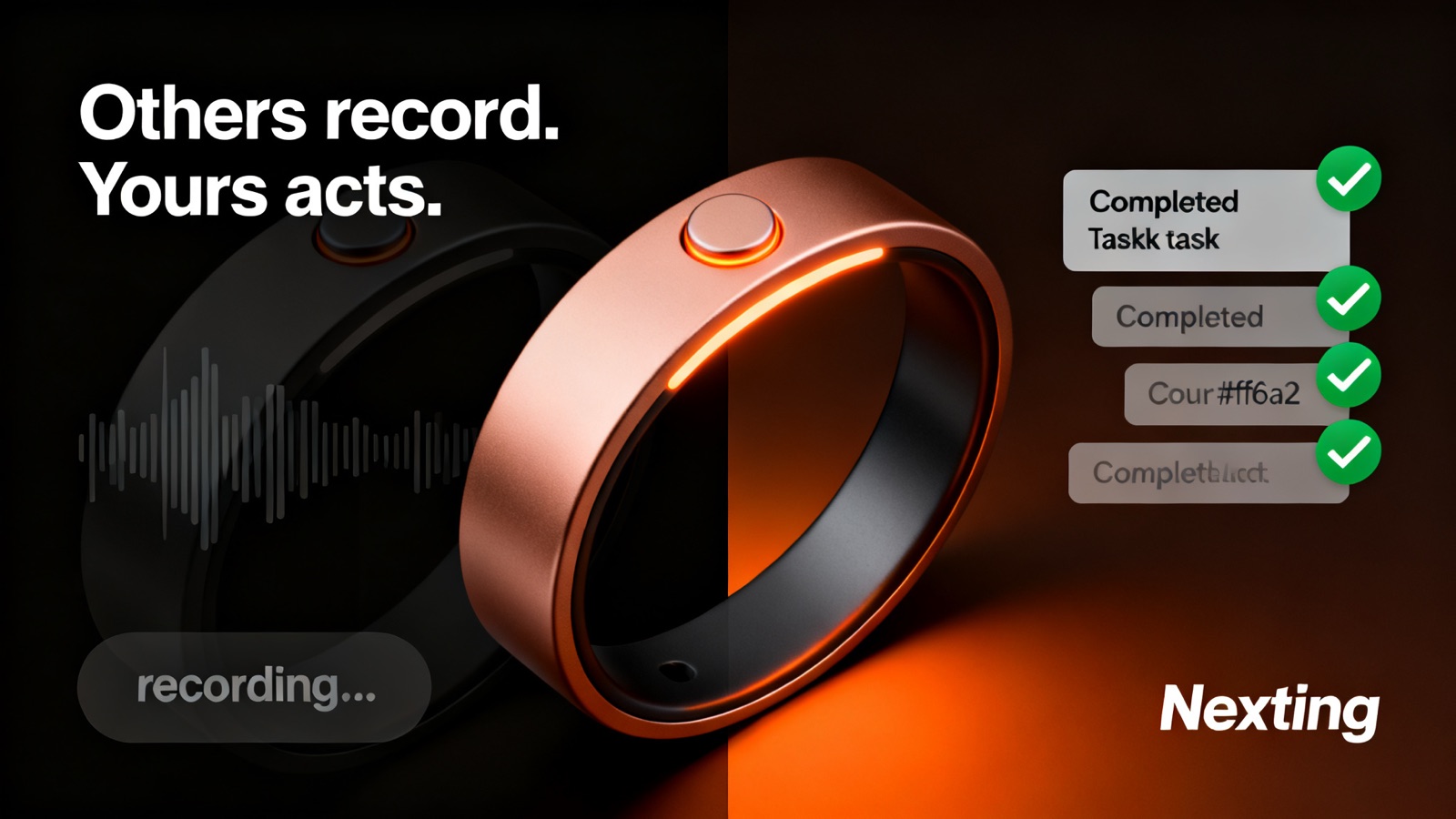
I build Nexting, so read this section with appropriate skepticism. I will keep it factual. Nexting is the remote-control layer for your personal AI agents: use the phone app, PIN, or Ring to reach your own AI agents anywhere. It is built around dispatch, not chat — one sentence out, the agent runs in the background, results come back, and they arrive even while your phone is locked or you are moving.
The deliberate difference from Humane is that Nexting does not try to be your phone, and it does not give you a captive assistant. It deeply integrates with the agents you already run — Claude Code, OpenClaw, and Codex — not “any backend” in the abstract, but those specific, capable agents. You can even remote-control a running Claude Code session from your pocket: dispatch a task, watch it work, answer its questions, and let it keep going while you walk away.
Price and the subscription question
The Nexting PIN is $129 and ships now, with free worldwide shipping. A separate $1 reservation locks the $104 Founder Edition offer. Bring-your-own-agent is free — if you already pay for Claude Code or run your own agents, the device does not add a tax to use them. For people who want a managed option, Nexting Plus (managed Claude, GPT-4o, and Gemini) is $29/mo or $279/yr — but it is genuinely optional, not the Humane model where the device is dead without the subscription. The flagship Ring has a refundable $1 reservation that becomes a $50 launch credit, with estimated fulfillment around Christmas 2026.
Privacy and survivability
Bring-your-own-agent modes run the agent on your own device. Optional end-to-end encryption is currently off by default; when enabled, your endpoints hold the keys and the cloud relays only ciphertext. The managed Plus tier needs the cloud, as any managed service does — that is the honest trade-off. Nexting itself is proprietary; only the Devices SDK is open source.
Where Nexting is not the right pick
To stay honest: if you want a polished, mainstream consumer gadget from a large company with retail support, Meta's glasses are a safer bet. If your only need is clean meeting transcripts, Plaud is more specialized. If you do not run or care about agents like Claude Code and just want a casual voice assistant, a dispatcher is overkill — the value of Nexting is highest precisely for people who already live inside capable agents and feel the pain of leaving them at the desk. And the hardware today is a Co-Builder Edition, 3D-printed rather than injection-molded at mass-market polish; that is the right expectation to set, not a spec to hide. I would rather you buy the device that fits your need than the one with my name on it.
A buyer's guide to not getting burned again
Whatever you choose — and it does not have to be mine — here is how to avoid being the person holding a bricked device a year from now. These questions fall straight out of the Humane post-mortem.
- Does it work if the company dies? Ask where the intelligence runs. If the answer is “our servers, behind our subscription,” you are buying a device with a remote off switch.
- Is the subscription mandatory or optional? A device that bricks without a monthly fee is renting you hardware, not selling it.
- Can you bring your own AI? Locked single-provider intelligence means you cannot upgrade or escape a model that disappoints you.
- Is it additive or substitutional? Anything trying to replace your phone has signed up for Humane's entire degree of difficulty.
- What happens to the recordings? For always-listening devices, find out who stores the audio and who owns the company.
- Has it actually shipped? Pre-launch promises are not a track record. Weigh shipping devices more heavily than slideware.
If a device answers these the wrong way, the price almost does not matter. Humane buyers did not lose $699 because $699 was too much for a great device. They lost it because the device was structurally disposable, and the structure was visible from the start.
What we still do not know
Honesty requires admitting the limits. The wearable AI category is young, and every device here — including Nexting — is still proving itself in the real world. Battery life under heavy daily use, voice accuracy in noisy environments, and long-term reliability are things you only truly learn after thousands of people wear a device for months. Anyone claiming those are solved is doing what Humane did: earning adjectives in marketing that the hardware has not yet earned in the field.
There are also open questions the whole category shares. How well do agents actually perform when driven by voice in five-second bursts on the move? How do you handle the moment an agent needs a decision and you are mid-conversation with a human? How private can an always-available device truly be once you add convenience features? These are real, unsolved problems, and the right posture is to treat the entire space as early — promising, but early.
What is settled is the diagnosis. Humane proved, expensively, that the phone-replacement framing is a dead end, that mandatory subscriptions plus phone-tier pricing repel buyers, and that intelligence living solely on a vendor's servers is a liability the moment that vendor falters.
There is one more thing worth saying plainly to anyone still smarting from the Pin. Skepticism toward the whole category is rational and earned — you watched a celebrated, well-funded product brick itself on a schedule. But do not let a single bad bet calcify into the belief that nothing here can work. The personal computer had its Apple Lisa, the smartphone had a graveyard of stylus-driven PDAs, and the tablet had a decade of failures before the iPad. First attempts at a category routinely aim at the wrong target and miss expensively. That is not evidence the category is fake; it is how categories find their shape. The useful response is not cynicism but a sharper set of questions — the seven requirements — applied coldly to whatever comes next.
Quick answers to the questions people actually search
What happened to the Humane AI Pin?
Humane announced it was shutting down on February 18, 2025. HP acquired its software, more than 300 patents, and most of its staff for $116 million, but pointedly did not buy the AI Pin hardware business. Sales stopped immediately and existing Pins lost server connectivity at 3:00 p.m. ET on February 28, 2025 — after which they could no longer make calls, answer queries, or reach the cloud. Refunds were limited to recent buyers within a 90-day window.
Why did the Humane AI Pin fail?
Two reasons, one tactical and one strategic. Tactically, it was unreliable: slow voice responses, wrong answers, two-to-four-hour battery life, overheating (its Charge Case was recalled for a fire hazard in October 2024), and a hard-to-read palm projector. Strategically — and this is the deeper cause — it tried to replace the smartphone at a higher total cost while doing less, locked you to a single AI provider behind a mandatory $24/month subscription, and ran all its intelligence on servers it later switched off.
What is the best AI pin in 2026?
There is no single best; it depends on the job. For meeting transcription, Plaud. For camera-first capture and casual queries, Meta Ray-Ban. For a cheap daily life-logger, Bee. For companionship, Friend. For dispatching your own capable agents — Claude Code, OpenClaw, Codex — from your body without a mandatory subscription, the Nexting PIN at $129 is the option built around that model. Match the device's model to your need rather than chasing a universal winner.
Is there an AI wearable that actually works?
Yes — if you define “works” as a device that does a narrow job reliably rather than one that replaces your phone. The devices earning real daily use in 2026 all share that humility. The category as a whole is still early, so weigh shipping devices and clear, narrow value over sweeping promises, and apply the seven requirements above before you buy.
The takeaway
If you are searching for a Humane AI Pin alternative, resist the urge to find the next single magical gadget. Find the device whose model is right. The Pin failed because it set out to replace the irreplaceable, charged you twice for the privilege, locked you to one fading brain, and kept that brain on its own servers until it pulled the plug. Every one of those is avoidable, and the best of the next generation avoids them.
And keep the timeline in perspective. The Pin went from one of the most anticipated launches in years to a remotely disabled paperweight in under twelve months. That speed is frightening if you bought one, but it is also clarifying for everyone shopping now: the market sorted a bad product from the viable models faster than almost any hardware category in memory. The information you need to choose well is already on the table, paid for by Humane's early adopters. Use it. Ask where the intelligence lives, ask whether the subscription is optional, ask whether the thing survives its maker, and ask whether it is trying to add to your life or replace the device you already love.
The most useful frame I can leave you with is this: you almost certainly do not want to replace your phone, and you almost certainly already have AI you trust. The job of a wearable is not to be a new, lesser brain bolted to your chest. It is to let the intelligence you already own reach you in the moments your phone cannot — to dispatch, deliver, and get out of the way. Whether you buy a Nexting PIN, wait for Button, settle on Meta's glasses, or run Happy on hardware you build yourself, hold the device to the seven requirements. The era is real. The first attempt just aimed at the wrong target.
Sources: TechCrunch — Humane's AI Pin is dead, HP buys assets for $116M; Fortune — HP acquiring parts of Humane for $116 million; U.S. CPSC — Humane Charge Case recall (fire hazard); CNBC — Amazon to buy AI wearable startup Bee.
Meet Nexting PIN — $129
An Agent remote-control product. Wear it, say one sentence, and your own agents — Claude Code, OpenClaw, Codex — finish the work in the background.
Buy now